
Credit quality of Indian corporate is expected to be stable in the second half of the current financial year (H2FY26), supported by easing monetary cycle, and declining inflation, coupled with income-tax relief and rationalisation of the goods and service tax (GST) rates, among others.

'...then preparing oneself for the long haul is also essential.' 'Identifying and holding onto values gives you strength to withstand the difficulties enroute.' 'Taking care of your physical, mental, and intellectual well-being gives you the strength to stay the path.'

Chief Economic Adviser (CEA) K V Subramanian on Tuesday exuded confidence that India would achieve double-digit growth in the current financial year on the back of policy initiatives and continuing reforms. He also said the country is well poised to meet the fiscal deficit target of 6.8 per cent of GDP. "At this stage, I can say confidently that we should be able to achieve that fiscal deficit number. "Any shortfalls that might happen on the disinvestment side will also be accompanied by positive surprises that have happened on tax revenue," he told reporters.
The truth can no longer be hidden despite 'headline management' by the ruling dispensation, the opposition party said.

With decline in number of fresh COVID-19 cases and easing of restrictions, the country's gross domestic product (GDP) will grow at 8.5 per cent in FY2021-22, according to credit rating agency Icra Ratings. It expects the gross value added (GVA) at basic prices (at constant 2011-12 prices) to grow at 7.3 per cent in FY2022. "The impact of the second wave of COVID-19 and the ensuing state-wise restrictions was seen across a variety of high frequency indicators in April-May 2021.
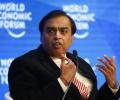
What manufacturing was for China, super intelligence will be for India: Ambani

'Returning Indians can leverage their international skills and the strong funding environment for start-ups here.'

Prime Minister Narendra Modi on Saturday proposed a G20 initiative aimed at enhancing clean energy transitions by boosting recycling, easing supply chain pressures and advancing joint research on critical minerals, and suggested forging a partnership to make satellite data more accessible and interoperable.

The country's biggest carmaker, Maruti Suzuki India, has raised concerns about the continuing slide in small car sales.

Instead of failing young Indians, the government should now focus laser-like on education, skilling, healthcare, and the environment, says Mihir S Sharma.

The fall in production of rice and oilseeds pulled down the growth in the agriculture sector to 2.9 per cent in the first quarter of the current fiscal, even as wheat and cotton output increased.

Days after Moody's cut its gross domestic product (GDP) forecast for financial year 2022-23 (FY23) after the official GDP print for the June quarter came in lower than expectations, the global ratings agency said it would maintain its long-term sovereign debt credit rating and outlook on Asia's third-largest economy. "The credit profile of India reflects key strengths, including its large and diversified economy with high growth potential, a relatively strong external position, and a stable domestic financing base for government debt," Moody's said on Tuesday. "We do not expect rising challenges to the global economy, including the impact of the Russia-Ukraine military conflict, higher inflation, and the tightening financial conditions on the back of policy tightening, to derail India's ongoing recovery from the pandemic in 2022 and 2023," it said.

Foreign investors continue to show confidence in the country's equity market, infusing Rs 14,167 crore so far this month, largely driven by favourable global cues and robust domestic fundamentals. Notably, this inflow has come despite the ongoing military tensions between India and Pakistan.

After bumbling for years since 2014, the Modi government seems to believe that massive government expenditure will lead us to prosperity supported by 'seat-of-the-pants' decision-making, observes Debashis Basu.

India will be the world's third-largest economy by 2028 as it becomes the world's most sought-after consumer market and gains share in global output, driven by macro stability influenced policy and better infrastructure, Morgan Stanley said. From a $3.5 trillion economy in 2023, the Indian economy is projected to expand to $4.7 trillion in 2026, which will make it the fourth largest in the world behind the US, China and Germany.

Indian economy is expected to expand at 8.5-9 per cent over 10-15 year time frame once the structural issues hampering growth are addressed by the government.

The Reserve Bank of India's (RBI) Monetary Policy Committee's (MPC) decision to cut the repo rate by 50 basis points (bps) to 5.5% was contrary to the expectations of many economists. Firstly, most of the economists expected the MPC to cut the repo rate by 25 bps citing the weakening of inflation, prospects of economic growth, geopolitical uncertainty and comfortable system liquidity.
The Reserve Bank of India has left the bank rate and repo rate unchanged at 6 per cent and 4.5 per cent, respectively.

Google plans to invest $15 billion over the next five years in setting an artificial intelligence hub in Visakhapatnam, a senior official of the company said on Tuesday.

'The bull market cycle ran for five years. It's the end of that cycle.' 'The next cycle is a down cycle, and in that down cycle, you will see the Sensex falling from their highs of around 68,000 to maybe 40,000-50,000 at the bottom of the cycle.'
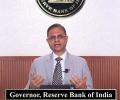
'India has the potential to grow at more than 7%, with the monetary policy providing a supportive hand.'

Wholesale price inflation (WPI) softened to 0.13 per cent in September on easing in prices of food articles and manufactured items, government data showed on Tuesday. WPI-based inflation was 0.52 per cent in August and 1.91 per cent in September last year.

The Budget should undertake further reductions in import tariffs and seriously consider an announcement of India's intention to join one or both of the two Asian mega-regional free trade agreements, suggests Shankar Acharya, former chief economic adviser to the Government of India.

Merchandise exports to the US jumped 23.5 per cent year-on-year (Y-o-Y) to $8.3 billion in June, even as India's overall outbound shipments witnessed contraction during the month, according to the data released by the commerce department on Tuesday. The increase in outbound shipments to the US was largely driven by the rush among exporters to utilise America's pause on its plans to impose country-specific reciprocal tariffs.


In a double-dose bid to boost growth and employment prospects, the Union Cabinet on Tuesday approved a Rs 2.07 trillion outlay for a research development and innovation (RDI) Scheme to fund private sector innovations, and an employment-linked incentive (ELI) to create over 35 million new jobs over the next two years.

We are, therefore, setting up more branches in more tertiary terms, like tier 2 and tier 3 terms. Going forward, that is where the growth will come.

Indian economy is likely to expand in the range of 5.4 to 5.9 per cent this fiscal, as per government estimates.

India's steel market is out of step with global trends. Global demand is weak with China at a huge supply surplus to its domestic demand, pushing down global steel prices. India's domestic demand for steel is strong, given the continuing infrastructure push and is likely to accelerate as urbanisation improves, and the auto sector continues to grow alongside the infrastructure push.

the GDP estimates incorporate new source data and modified compilation techniques

Recalibrating data of past years using 2011-12 as the base year instead of 2004-05, the Central Statistics Office estimated that India's GDP grew by 8.5% in the financial year 2010-11 and not at 10.3% as previously estimated.

Looking under the hood, I see India on the terrible, but commonplace, road to prosperity failure, warns Rathin Roy.

For India to transform into a high-income country with a projected gross domestic product (GDP) of $23-35 trillion, will need a sustained annual growth of 8 per cent to 10 per cent. This will be powered by India's demographic dividend, technological innovation, and sectoral transformation, according to the "India@2047: Transforming India Into A Tech-Driven Economy" report by Bain & Company and Nasscom. By 2047, the services sector is expected to contribute 60 per cent of India's GDP, while manufacturing will account for 32 per cent, both playing a pivotal role in economic expansion.

Haryana has done well in terms of economic growth over the last couple of decades. For it to continue to lead the growth ladder, the new government has to work hard on multiple dimensions, recommend Shishir Gupta and Rishita Sachdeva.

India's extreme poverty rate declined sharply to 5.3 per cent over a decade from 27.1 per cent in 2011-12 even as the World Bank revised upwards its threshold poverty line to $3 per day.

Shiv Nadar and family donated Rs 2,708 crore (Rs 27.08 billion) in 2024-2025.
If the current growth trend in the IT industry continues, software and IT services will contribute 8 per cent of the country's gross domestic product by 2008, Nasscom president Kiran Karnik said on Saturday.

Manufacturing sector grows at 3.5%; agriculture sector at 3.8%

The previous high GDP growth of 8.1 per cent was recorded in April-June quarter of 2016-17.
